Showing posts with label Paul Jackson. Show all posts

Thursday, 12 January 2017

Cut and Fold Paper Textures, by Paul Jackson. Review.


Cut and Fold Paper Textures:

Techniques for Surface Design

By Paul Jackson

Laurence King Publishing, January 2017

Paperback, £16.99

ISBN 978-1-78067-861-0


Star rating: ****


Here’s an antidote to the January doldrums – a  new title from papercraft design go-to guy, Paul Jackson. The topic this time is surface texture – the author’s aim is to get you thinking in 3-D, with paper itself as a “structural material”. As the author says, “perhaps we are too quick to accept paper’s traditional role as a ground (for printing and drawing on)". So, with the goal of imparting surface interest, the author examines 12 different techniques: twisting, weaving, layering, coiling, tearing, bending, pleating, crumpling, incising and lifting, cut pleats, stippling, and translucent surfaces. Surface textures are having a well-deserved fashion moment - and Paul Jackson's book is his papery take on the phenomenon.


Each chapter introduces a technique with accompanying how-tos, then progresses to monochrome examples, two-colour examples, then finally all-singing, all-dancing full-colour examples. Lots of accompanying inspirational photos – not all of papercraft projects (but all of the projects would have initially been inspired by the featured papercraft technique).This ramping-it-up format works a treat.


The chapter on twisting looks in on the little-used technique of fashioning things out of coiled paper twine. And the chapter on Coiling is a celebration of quilling – a papercraft that has recently been shaking off its fusty image (not that we didn’t already love it).The chapters on tearing and folding explain how to work with the grain of the paper. The chapter on Incising and Lifting showcases patterning achieved by papercutting – but this is cut-and-pierced paperwork, not papercutting with fully-evacuated holes. A magical element can be added to cut-and-pierced designs through the addition of backlight – or backing paper. The chapter on Stippling is about creating pointillist effects by needle-piercing or paper indentation. The chapter on Translucent Surfaces is about creating layered stained-glass-like effects.These designs are reverse-engineered - literally, layered and lit from behind. So - endless variety to highlight the chameleon-like transformative power of paper. 


Dip into this book if you are looking to try a new papercraft technique, or if you wish to add excitement to a project in progress. It is an excellent resource. All of the techniques can be achieved by the casual crafter without difficulty. 


Cut and Fold Paper Textures is the most recent addition to an indispensable range of Paul Jackson papercraft design titles for Laurence King Publishing. If you have more than a passing interest in papercraft techniques, then you should assemble this library. They are my constant references – a pleasure each time I consult them. You can learn about all aspects of paper manipulation – pleating, folding, one-sheet pop-ups, how to design a box (this can get pretty sophisticated). A veritable Disneyland of paper manipulation techniques!
Paul Jackson papercraft library.
 

Note: I was supplied with a review copy of this title.


Monday, 5 October 2015

Twisted Ring Ornaments

In my previous post, I featured Paul Jackson's new book, Complete Pleats:
I just couldn't wait to get paper-pleating. The above ornaments are slightly enhanced versions of Paul Jackson's Twisted Rings, which are featured in Chapter 3.4, pages 166-171. The concept is that each twisted ring is based upon a polygon - mine use hexagons and octagons. The shape is broken down into a strip of paper divided into segments with angled folds. The folds are angles that appear within the shape. Mountain and valley folds are alternated. When the ends of the strip of paper are joined, a nifty spiralling shape that folds flat is formed. Fun to make and play with. Boing!

You will soon get the hang of it, since I have have designed some print-and-cut twisted rings for you. They can be hung with a ribbon loop, joined to make chains, or glued together in stacks to make towers than scrunch down flat!
The printed stripes can be positioned on the inside or the outside of the ring, depending on how the strip of paper is folded. See the diagram above - it is a simple matter of alternating mountain and valley folds in the correct sequence.

To make a Twisted Ring Tower, simply glue the tabs of adjacent rings together. Stack 'em high!

Here are your print-and-cut twisted rings:
HexagonTwistRing.pdf 
OctagonTwist.pdf 

HexagonTwistRing.studio3 
OctagonTwistRing.studio3 


Tuesday, 18 February 2014

One-sheet Pop-Ups

Card above, folded flat.
Yesterday I featured Paul Jackson's new book on simple one-sheet pop-ups. For today's post, I've done a quick study and come up with the cards above. Still on my training wheels - nothing really fancy in the cut-and-fold department, but I think you can see how one-sheet pop-ups can be very effective - and fun.
I added a strut to the designer shopping bag birthday card, so that it can be propped up, easel-style (but it still fits on a single sheet of A4 cardstock). The shopping bag also has a gift tag, as an additional feature.
Here are your printable cards:
FlowerThanksPop-Up.pdf 
FlowerpotThanksPopUpSelect.pdf
ShoppingBagBirthdayPopUp.pdf
The flowerpot and shopping bag cards have how-tos printed on-page, to talk you through the cutting and folding.
The flower Thanks card is pretty simple - so no on-page instructions.
Just cut the card out, cut the scalloped slit with a craft knife, then score the folds. Examine the photo to see how the card is folded, taking notice of mountain and valley fold directions.
These cards collapse down flat for posting. The flower card and the shopping bag card fold down into neat rectangles. The flowerpot card folds down into an irregular shape, which is more than compensated for by the surprise factor when the recipient opens it up in its 3-D splendour!
Don't forget to check out Paul Jackson's new book to learn about designing your own one-sheet Pop-Ups.


Monday, 17 February 2014

Pop-Up Designs by Paul Jackson: Book Review

Cut and Fold Techniques for Pop-Up Designs

By Paul Jackson

Laurence King Publishing, March 2014

128 pages

Paperback, £15.95

ISBN 978 1 7806 7327 1


Star rating: *****


Papercraft expert extrordinaire Paul Jackson is back with a new addition to his excellent series of papercraft design titles for Laurence King Publishing. The subject of this title is pop-ups – I know, smile – but the content of the book is not what you are probably expecting. No, it is not slide-rule time for paper engineering geeks, but rather a streamlined system for designing one-page pop-ups

Written with the design professional in mind, the idea is to create a simple, attention-grabbing 3-D pop-up suitable as a backdrop for printed advertising – from just one sheet of card. Clock that, papercrafters: no gluing, nothing fancy. Stunning results from just one sheet of cardstock. According to the author, the technique “creates ‘negative’ (or empty) spaces behind sections of card which have been cut and folded to stand forward, so for every negative void there is an equivalent ‘positive’ of card.” The results are dramatic – sculptural, even architectural. Card-makers: this is the mother lode!

Like all of Paul Jackson’s titles in the series, you are taught the principles of the concept so you can master it and design for yourself. You learn how to create combinations of folds and cuts to make 3-D pop-ups that fold down flat. The first chapter shows how a simple slit in a piece of card can produce a variety of results, depending on how the paper is folded. In Chapter 3, Developing the Basics, you learn how to “Take the Cut for a Walk” – make a more complex cut line to create striking results. When varying the card silhouette is added to this, your options are multiplied bigtime (curvy or zigzag cut + different card outline shape = infinite possibilities). Chapter 4 is Releasing the Folded Edge. Here, you learn to create projecting sections along a crease to dramatic effect. Designs that really stand out! Chapter 5 is Multiple Gutters and Generations – fancy facetted creations – one-page pop-up graduate school, you might say.  Wow factor and something to aspire to. 
This book accomplishes its aim of teaching a specific papercraft design skill. It achieves this aim clearly, concisely, in style, and with humour and enthusiasm. 
Don’t forget to check out Paul Jackson’s other titles for Laurence King. You can build up a mini-library of papercraft titles to add to your papercraft expertise. Although written with the design professional in mind, these titles are user-friendly and completely accessible to the hobbyist papercrafter.

These titles are:

Structural Packaging: Design Your Own Boxes and 3-D Forms

This title, my personal favourite, is indispensible. It teaches you how to design a net – the 2-D pattern template for making a 3-D box.

Folding Techniques for Designers

This book is ideal for origami enthusiasts. It teaches how to create fancy multi-facetted folds ( these are currently in vogue for lampshades).

Cut and Fold Techniques for Promotional Materials

Fun stuff! Interactive novelty designs, such as flexagons - neverending movable folded shapes. The chapter on envelopes is superb.


In my next post, I’ll be featuring some one-page pop-ups that I’ve crafted after doing a quick study of Paul Jackson’s new book.

Note: I was given a review copy of this title.


Monday, 2 December 2013

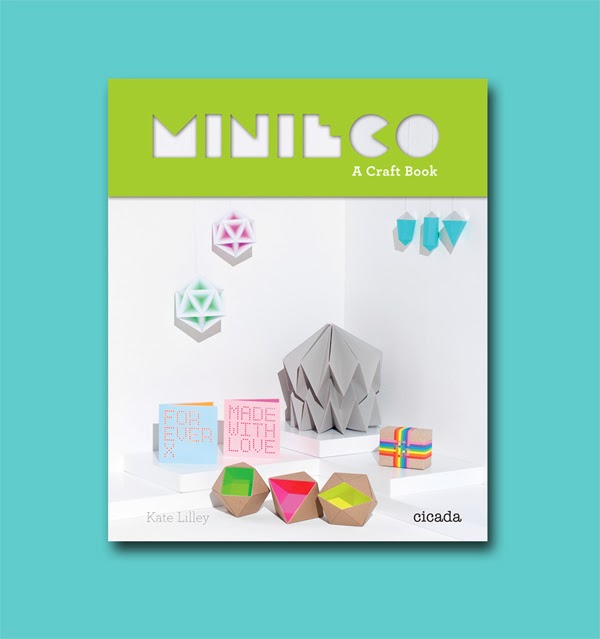
Book Review: Mini-Eco


MiniEco: a Craft Book

By Kate Lilley

Cicada Books

Paperback  £14.95

ISBN 978-19-08714-09-1


Star rating: ****


MiniEco is a mega-blogger (over 250,000 followers!). What makes Kate Lilley a star are her ingenious and quirky crafty ideas – many of  which are papercrafts , “her medium of choice”. She’s got bags of retro-funky style and a ginormous sense of fun. This is the book of the blog. It contains 31 choice projects,  many of which are papercrafts.

I’m a sucker for comeback success stories, and Kate Lilley’s is a great one. She has a degree in Fine Art, but found herself in web design to pay the rent. She says that she had a ten-year creative dry spell, which ended when she became a parent. Devising inexpensive, eco-conscious toys for her kids re-ignited her crafty inspiration. And her techie nous helped her to create an ace on-line presence. The triumph of transferable skills!
Pop-Up Pixel Cards: retro-winners!
Many of MiniEco’s trademark projects are inspired by 1980’s computer graphics. The Pop-Up Pixel Cards (pic above) are winners, inspired by “Space-Invader”-type computer images. The stair-step construction lends itself to the necessary papercutting. A very clever finishing touch is the Day-Glo backing paper, which gives the designs a screen-like “neon” glow.  The Dot Matrix Cards, super-graphic messages achieved with a long-reach paper punch, have the same retro 80’s feel.  And it is an idea which you can adapt yourself for other cards.  Another retro-typographic idea is the 3D 8-Bit Font, jumbo chunky cardboard letters which can be used to spell out messages. What I love about these is that the zig-zag pattern templates for the letters are things of beauty in their own right, before you assemble them into their final form.
Great Dodecahedrons: the gradient adds "glow".

Like me, MiniEco is a Fan of papercraft  guru Paul Jackson. She has absorbed the papercraft construction know-how put forth in his books (Folding Techniques for Designers,Structural Packaging) and come up with some super projects. Check out the Great Dodecahedron (pic above), a 3-D hanging decoration which can be made up in a gradient version,  templates downloadable from the MiniEco website. Sort of a cardstock Bucky Ball. There’s also a pleated Paper Lampshade – a very fashionable look. Similar lampshades are available expensively online - but if you are up for a fun (and challenging) bit of fancy folding, you can make Mini-Ecos pennywise design.

There are several projects inspired by facetted gems: 3-D Paper Gems and Spray-Painted Chalk Stencils (depicting gems). (I’ve done the gem thing myself:Jewel Boxes).

It is refreshing to see lots of geometrically-inspired projects. So many craft titles are aimed at the “girly” market – you know, hearts and flowers, ribbon and lace. Here, you will find many unisex ideas that can be made for or with the kids. (This is not a children’s craft book, although most of the projects have kid-appeal. Probably because the author is joyfully rediscovering many of the crafts she learned as a child: Spirograph Wrapping Paper, Lego Sign, a trio of macramé projects.)


This is a really hands-on book. For the non-papercraft projects, MiniEco is ready to use all sorts of craft techniques: Hama Bead Candle Holders, which are threaded together using a Peyote Stitch construction method. Other projects involve simple sewing – or some woodworking lite (drill and sandpaper).

Each project is given a star-rated skill level – a useful guide. Some have scannable QR codes, so you can zoom into online info (it would have been great for all projects to have this feature). Written step-by-steps are provided –  with how-to illustrations where required. This works fine. And there is a generous sprinkling of hints, tips, and extension ideas. 

This is a really good “taster” book- it does indeed capture the originality and spirit of the MiniEco blog - geek chic with a tweak. I wanted more – so I hope there’s a follow-up title to come.


Note: I was supplied with a review copy of this title.